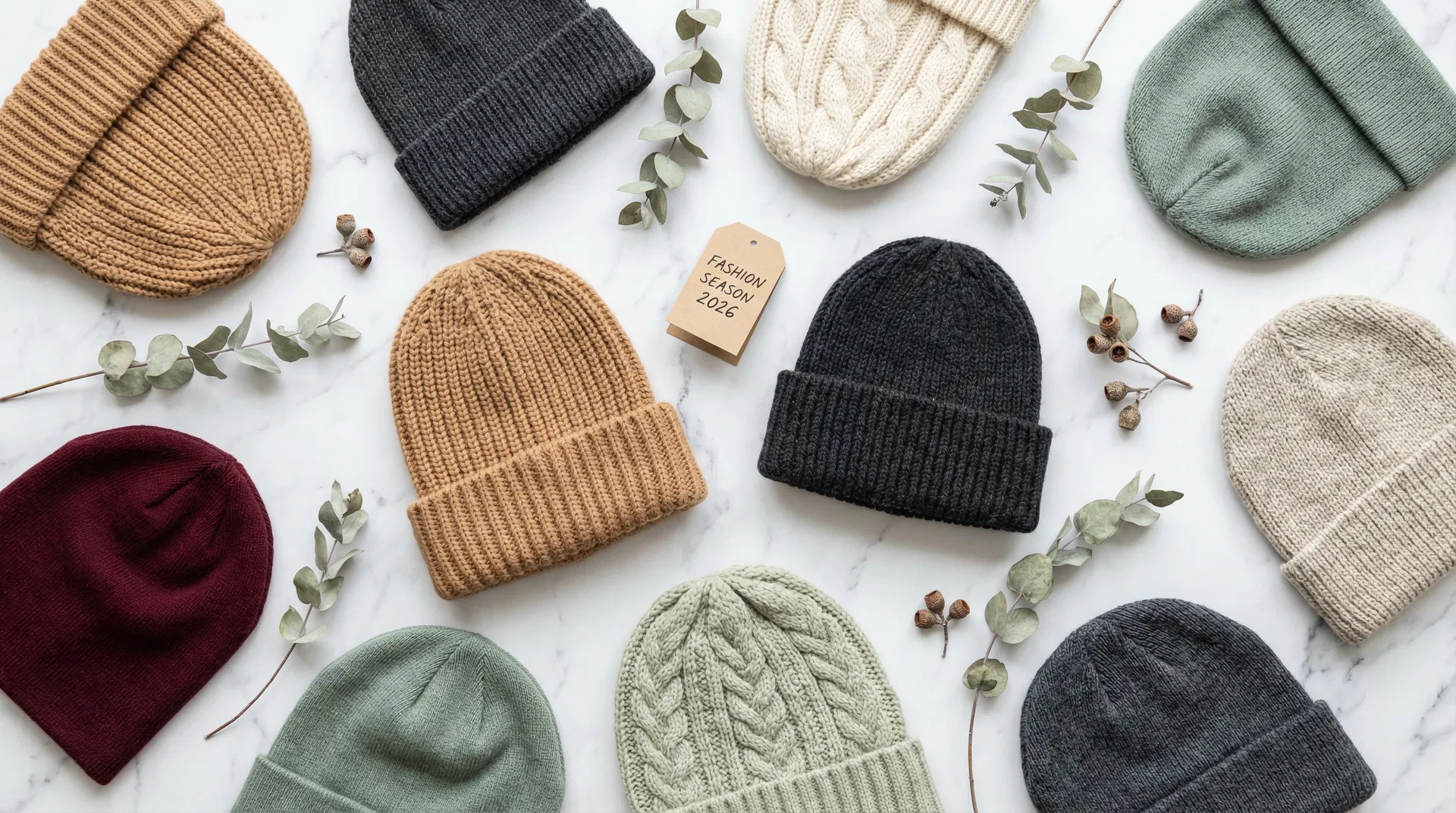
The winter accessories market continues to evolve, with 2026 bringing a compelling mix of heritage craftsmanship, sustainable innovation, and bold fashion statements. For retailers and brands planning their winter collections, understanding these trends early is essential for making informed sourcing decisions.
Based on runway analysis, trade show observations, and our direct experience manufacturing for European fashion brands, here are the top 10 knitted hat trends shaping the 2026 retail season.
1. Chunky Ribbed Beanies
The chunky ribbed beanie continues its reign as the dominant winter hat silhouette for 2026. What has changed is the emphasis on exaggerated proportions — wider ribs (2x2 or 3x3 rib patterns), deeper crowns, and generous fold-over cuffs that create a substantial, cozy silhouette.
Manufacturing notes: These styles work best in 3GG to 5GG gauge on flat knitting machines, using bulky or super-bulky weight yarns. Wool/acrylic blends (50/50 or 30/70) offer the ideal balance of warmth, structure, and affordability. For premium lines, consider 100% merino wool in 19.5-micron for exceptional softness.
Retail price positioning: Mid-range ($15-25 for acrylic blends) to premium ($35-55 for pure wool/merino).
2. Earth Tone Color Palettes
The color story for Winter 2026 is firmly rooted in nature. Warm earth tones dominate: camel, oatmeal, sage green, terracotta, burgundy, and chocolate brown. These colors reflect the broader fashion movement toward understated elegance and versatility.
The key shift from previous seasons is the move away from bright, saturated colors toward muted, tonal palettes. Brands are offering collections in coordinated earth-tone families rather than individual statement colors.
Sourcing tip: When ordering multiple styles in earth tones, request yarn lab dips from the same dye lot to ensure consistent color harmony across your collection. At Best Link, we can provide coordinated Pantone color families for your seasonal range.
3. Cable Knit Revival
Cable knit patterns are experiencing a significant revival, moving beyond traditional Aran-inspired designs into modern interpretations. Key variations include:
- Oversized single cable running down the center of the beanie - Mixed cable patterns combining different cable widths in one piece - Cable knit with contrasting textures — smooth stockinette panels alongside cable sections
Cable knit hats command higher retail prices due to the perceived craftsmanship and the actual complexity of production. They are particularly strong sellers in the European market, where consumers associate cable knit with quality heritage knitwear.
Manufacturing notes: Cable patterns require more yarn (typically 15-20% more than plain knit) and slower machine speeds, which affects unit costs. Factor this into your pricing strategy.
4. Sustainable and Recycled Materials
Sustainability is no longer a trend — it is a baseline expectation, especially in the European market. For 2026, the specific focus is on:
- Recycled polyester and recycled acrylic yarns that offer familiar performance at lower environmental cost - Organic cotton (GOTS certified) for transitional season beanies - RWS (Responsible Wool Standard) certified wool for brands making animal welfare commitments - Recycled cashmere blends that offer luxury positioning with a sustainability story
Retailers are increasingly requiring sustainability certifications as a condition of purchase orders. Brands that cannot demonstrate certified sustainable sourcing risk losing shelf space.
Best Link advantage: Our GOTS and OCS certifications enable us to produce verified organic and sustainable products with full chain-of-custody documentation.
5. Knitted Hoods and Balaclavas
One of the most distinctive trends for 2026 is the knitted hood — a hybrid between a beanie and a scarf that covers the head, ears, and neck in one piece. Balaclavas, once purely functional, have been elevated to fashion statements by luxury brands and are now filtering into the mainstream market.
Variations include:
- Open-face balaclavas that frame the face while covering the head and neck - Detachable hood-scarf combinations that offer versatility - Knitted snoods that can be worn as a neck warmer or pulled up over the head
Manufacturing notes: These products require more complex construction and more yarn than standard beanies, but they command significantly higher retail prices ($30-60 for mid-range). They are excellent margin builders for brands.
6. Minimalist Design Language
In contrast to the maximalist trends of recent years, 2026 sees a strong movement toward minimalist knitted hats. Clean lines, single-color designs, and subtle branding characterize this trend. The focus is on perfect proportions, premium materials, and impeccable finishing rather than decorative elements.
Key features: - Tonal logos — brand marks in the same color as the hat, creating a subtle embossed effect - Clean edges — precisely finished cuffs and crowns without visible seams - Monochromatic styling — matching hat, scarf, and glove sets in identical colors
This trend aligns perfectly with the "quiet luxury" movement in broader fashion and appeals to consumers who value understated quality.
7. Textured Knit Patterns
Beyond cables, a variety of textured knit patterns are gaining traction:
- Seed stitch / moss stitch — creates a subtle, nubby texture that adds visual interest without being overly decorative - Waffle knit — a structured, grid-like texture that is both visually appealing and functionally warm - Herringbone knit — a diagonal pattern that adds sophistication to basic beanie shapes - Jacquard patterns — geometric and Fair Isle-inspired patterns in tonal color combinations
Textured knits allow brands to differentiate their products without relying on color alone, which is particularly valuable when earth-tone palettes mean many brands are working with similar colors.
8. Fleece-Lined Premium Beanies
The demand for fleece-lined beanies continues to grow as consumers prioritize functional warmth alongside style. The 2026 evolution of this trend focuses on:
- Micro-fleece linings that add warmth without bulk - Merino wool outer with fleece inner — combining natural aesthetics with synthetic performance - Windproof membrane layers for outdoor and sport-oriented brands
Fleece-lined beanies typically retail at a 30-50% premium over unlined versions, making them attractive for brands looking to increase average order value.
Manufacturing notes: Adding a fleece lining requires a sewing step after knitting, which increases production time and cost. At our Hunan Tongmei factory, we have dedicated sewing lines with automatic cutting machines for efficient lining production.
9. Matching Accessory Sets
Coordinated hat, scarf, and glove sets are a perennial strong seller, but 2026 brings a more sophisticated approach:
- Mix-and-match collections — items designed to coordinate rather than match exactly, allowing consumers to create personalized combinations - Gift-ready packaging — sets packaged in attractive boxes or pouches for the gifting market - Family matching sets — coordinated designs for adults and children, particularly popular in the European market
Sets offer excellent value for retailers: higher average transaction values, simplified merchandising, and strong gift-season performance.
10. Baby and Children's Knitted Hats
The children's knitted hat market remains robust, with specific trends for 2026 including:
- Organic cotton and GOTS-certified materials — parents increasingly demand certified safe materials for children - Animal ear and character designs — playful elements that appeal to children while maintaining quality construction - UV-protective knits — lightweight knitted hats with UPF ratings for year-round use - Adjustable sizing — designs with drawstrings or elastic that accommodate growing children
At Best Link, children's accessories are one of our strongest categories, with our production for STERNTALER (Germany) covering a wide range of kids' hats, gloves, and baby clothing.
How to Act on These Trends
For retailers and brands planning their Winter 2026 collections, here is a practical timeline:
| Timeline | Action |
|---|---|
| March-April 2026 | Finalize trend selection and design briefs |
| April-May 2026 | Request samples from manufacturers |
| May-June 2026 | Approve samples and place production orders |
| July-August 2026 | Production period |
| September 2026 | Receive shipments and begin distribution |
| October-December 2026 | Peak retail season |
Starting the sourcing process early gives you the best selection of materials, competitive pricing, and reliable delivery schedules.
Conclusion
The Winter 2026 hat market offers exciting opportunities for brands that combine trend awareness with quality manufacturing. The overarching themes — natural materials, earth tones, textured craftsmanship, and sustainable sourcing — all point toward a market that values substance over novelty.
At Best Link, we are already producing samples for several of these trend categories and can help your brand translate these insights into commercially successful products. With two own factories, four major certifications, and 15+ years of European market experience, we are well-positioned to support your Winter 2026 collection.
Planning your Winter 2026 range? Contact us for trend-inspired samples and competitive quotations.
Found this sourcing guide useful? Share it with your product development, buying, or supply-chain team.