China remains the world's largest producer of knitted fashion accessories, accounting for a significant share of global production of hats, scarves, gloves, and related products. For fashion brands, retailers, and importers looking to source custom knitted accessories, understanding the OEM manufacturing process in China is essential for achieving the right balance of quality, cost, and reliability.
This comprehensive guide draws on Best Link's 15+ years of experience as a Hangzhou-based OEM/ODM manufacturer, serving brands across Europe including Germany, Poland, France, Norway, and Italy. We will walk you through every step of the process, from initial inquiry to final delivery.
Why China for Knitted Accessories?
China's dominance in knitted accessories manufacturing is built on several structural advantages:
Complete supply chain integration. China offers the entire value chain in close proximity — from yarn spinning and dyeing to knitting, finishing, and packaging. This vertical integration reduces lead times and communication gaps compared to sourcing from countries where different production stages are spread across regions.
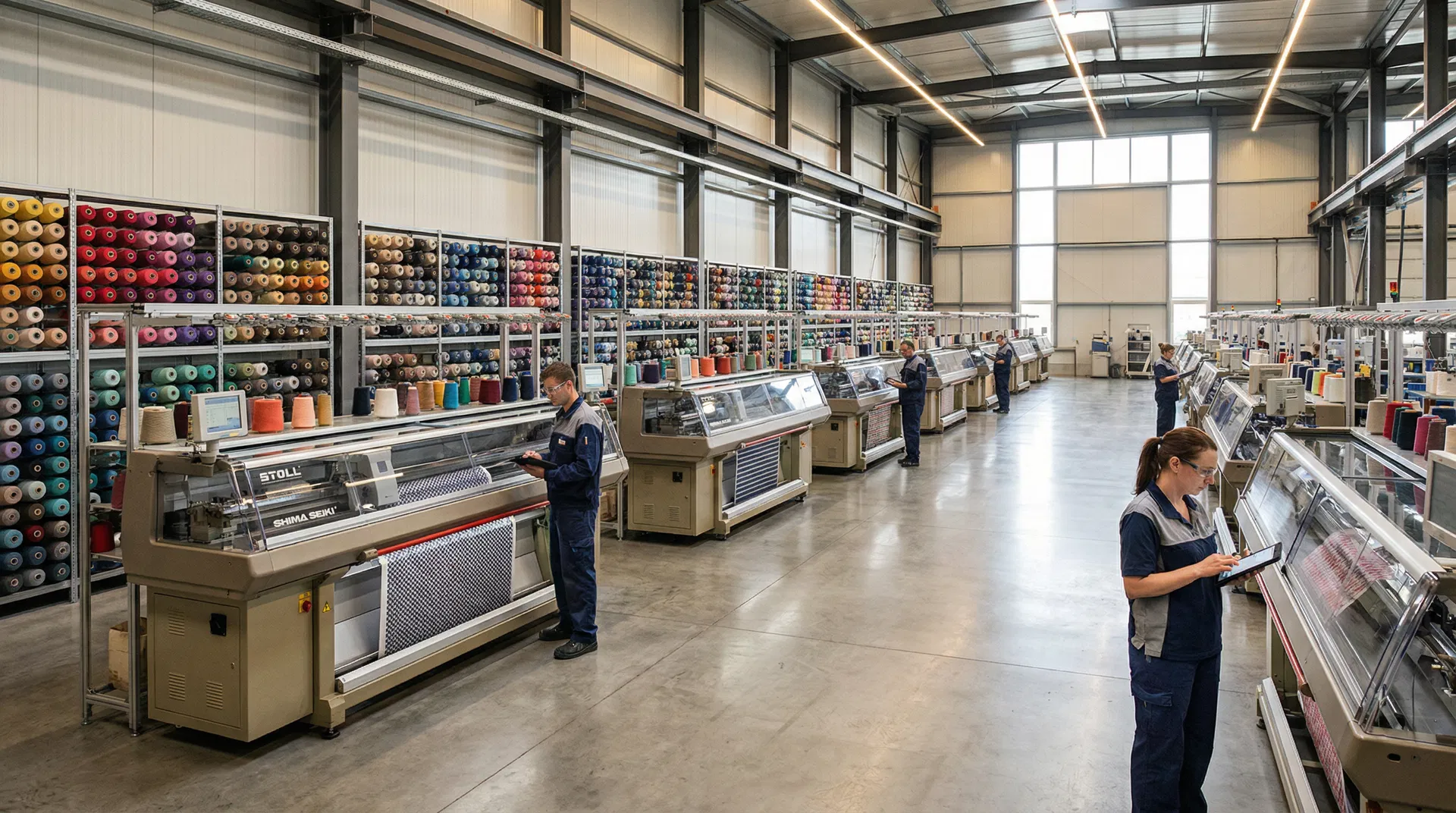
Advanced manufacturing technology. Chinese factories have invested heavily in computerized flat knitting machines (from brands like Shima Seiki and Stoll), automated cutting systems, and quality inspection equipment. At Best Link's Tonglu Jimei Knitting factory, we operate modern computerized flat knitting machines capable of producing complex jacquard, intarsia, and cable-knit patterns with high consistency.
Scalable production capacity. Whether you need 300 pieces for a boutique collection or 100,000 pieces for a major retail chain, Chinese manufacturers can scale production to match your requirements.
Competitive pricing. While not the cheapest option globally (countries like Bangladesh and Vietnam offer lower labor costs for basic items), China offers the best value proposition when factoring in quality consistency, design capability, and supply chain reliability.
The OEM Manufacturing Process: Step by Step
### Step 1: Initial Inquiry and Specification
The process begins when you provide your product specifications to the manufacturer. A complete inquiry should include:
| Information | Why It Matters |
|---|---|
| Product type and design | Determines which machines and techniques are needed |
| Material/yarn composition | Affects cost, lead time, and certification requirements |
| Color specifications (Pantone) | Ensures accurate color matching |
| Size range and measurements | Determines pattern programming |
| Quantity per style/color | Affects pricing tiers and production planning |
| Target FOB/CIF price | Helps manufacturer suggest appropriate materials |
| Required certifications | BSCI, GOTS, OCS, OEKO-TEX affect factory selection |
| Delivery timeline | Determines production scheduling |
| Packaging requirements | Custom labels, tags, poly bags, carton specifications |
Pro tip: The more detailed your initial inquiry, the more accurate your quotation will be. Vague specifications lead to misunderstandings and price adjustments later.
### Step 2: Quotation and Negotiation
Based on your specifications, the manufacturer will provide a detailed quotation covering:
- Unit price (typically FOB or CIF) broken down by style and color - MOQ (Minimum Order Quantity) — typically 300-500 pieces per style/color for knitted accessories - Sample cost — usually $50-150 per style, often refundable against production orders - Lead time — typically 45-75 days from sample approval to shipment - Payment terms — commonly 30% deposit + 70% before shipment, or L/C for larger orders
### Step 3: Sample Development
Sample development is the most critical phase. It typically involves:
- Counter sample (5-7 days): The factory creates a sample based on your specifications or reference sample. This is for fit, construction, and general appearance evaluation.
- Revised sample (3-5 days): Based on your feedback, adjustments are made to dimensions, yarn tension, color, or construction details.
- Pre-production sample (PPS) (5-7 days): The final approved sample using actual production yarn and trims. This becomes the reference standard for bulk production.
At Best Link, we typically complete the full sample development cycle in 2-3 weeks, depending on material availability and revision rounds.
### Step 4: Production
Once the PPS is approved and deposit received, bulk production begins:
Yarn preparation (3-5 days): Yarn is wound onto cones and prepared for the knitting machines. For custom-dyed colors, yarn dyeing may add 7-10 days.
Knitting (7-14 days): Computerized flat knitting machines produce the knitted panels. For our factory in Tonglu, we use advanced computerized flat knitting machines that can handle gauges from 3GG (chunky) to 14GG (fine knit).
Linking and sewing (5-10 days): Knitted panels are assembled — linking seams, attaching linings, sewing labels, and adding any embellishments.
Finishing (3-5 days): Washing, steaming, pressing, and final shaping to achieve the correct dimensions and hand feel.
Quality inspection (2-3 days): 100% visual inspection plus AQL sampling for measurements, weight, color consistency, and construction quality.
Packing and shipping (3-5 days): Products are packed according to your specifications (individual poly bags, hang tags, carton packing) and prepared for shipment.
### Step 5: Quality Control
Quality control should happen at multiple stages, not just at the end:
| QC Stage | Timing | What to Check |
|---|---|---|
| Incoming material inspection | Before production | Yarn weight, color, composition |
| In-line inspection | During production | Knitting tension, pattern accuracy, dimensions |
| Mid-production inspection | 30-50% completion | Random sampling against PPS |
| Final inspection | 100% completion | AQL 2.5 sampling, measurements, appearance |
| Pre-shipment inspection | Before loading | Packing, labeling, quantity verification |
AQL (Acceptable Quality Level) is the industry standard for sampling inspection. Most buyers use AQL 2.5 for major defects and AQL 4.0 for minor defects. At Best Link, we conduct 100% visual inspection on all products before the final AQL sampling.
### Step 6: Shipping and Logistics
Common shipping methods for knitted accessories:
| Method | Transit Time | Cost | Best For |
|---|---|---|---|
| Sea freight (FCL) | 25-35 days | Lowest | Large orders (10+ CBM) |
| Sea freight (LCL) | 30-40 days | Low-medium | Medium orders (1-10 CBM) |
| Air freight | 5-7 days | Highest | Urgent/small orders, samples |
| Rail (China-Europe) | 15-20 days | Medium | EU-bound orders, good balance |
Common Challenges and How to Avoid Them
### Color Matching Issues
Color is one of the most common sources of disputes. Always provide Pantone references and request a lab dip (yarn color sample) before production. Remember that the same Pantone color can look different on different yarn types — acrylic absorbs dye differently than wool.
### Size Inconsistency
Knitted products are inherently more variable than woven products due to yarn tension and finishing processes. Establish clear tolerance ranges (typically ±1-2cm) in your specifications and ensure the factory measures after finishing, not before.
### Communication Gaps
Work with manufacturers who have experienced English-speaking sales teams. At Best Link, our export team has 15+ years of experience working with European brands, ensuring clear communication and proactive problem-solving.
### Intellectual Property Protection
If you are providing proprietary designs, ensure your manufacturer signs an NDA (Non-Disclosure Agreement). Work with established, certified factories (BSCI, ISO 9001) that have reputations to protect.
Why Choose Best Link as Your OEM Partner
Best Link offers a unique combination of advantages for brands sourcing knitted accessories:
- Two own factories: Tonglu Jimei Knitting (computerized flat knitting) and Hunan Tongmei Garment (cut-and-sew, with automatic cutting and spreading machines) - 15+ years of European market experience: Proven track record with brands like STERNTALER (Germany), LPP/Reserved (Poland), LE PETIT SOUK (France), and SKOGSTAD (Norway) - Four major certifications: BSCI, GOTS, OCS, and ISO 9001 - Low MOQ: Starting from 300 pieces per style - Full product range: Knitted hats, scarves, gloves, headbands, baby clothing, and blankets - Free samples available: We provide samples for evaluation before committing to production
Conclusion
OEM manufacturing of knitted accessories in China offers an excellent combination of quality, capability, and value — provided you work with the right partner and follow a structured process. By understanding each step from inquiry to delivery, maintaining clear communication, and implementing robust quality control, you can build a reliable supply chain that supports your brand's growth.
Ready to start your next knitted accessories project? Contact Best Link for a free consultation, factory profile, and sample evaluation.
Found this sourcing guide useful? Share it with your product development, buying, or supply-chain team.